What's hiding inside the slab
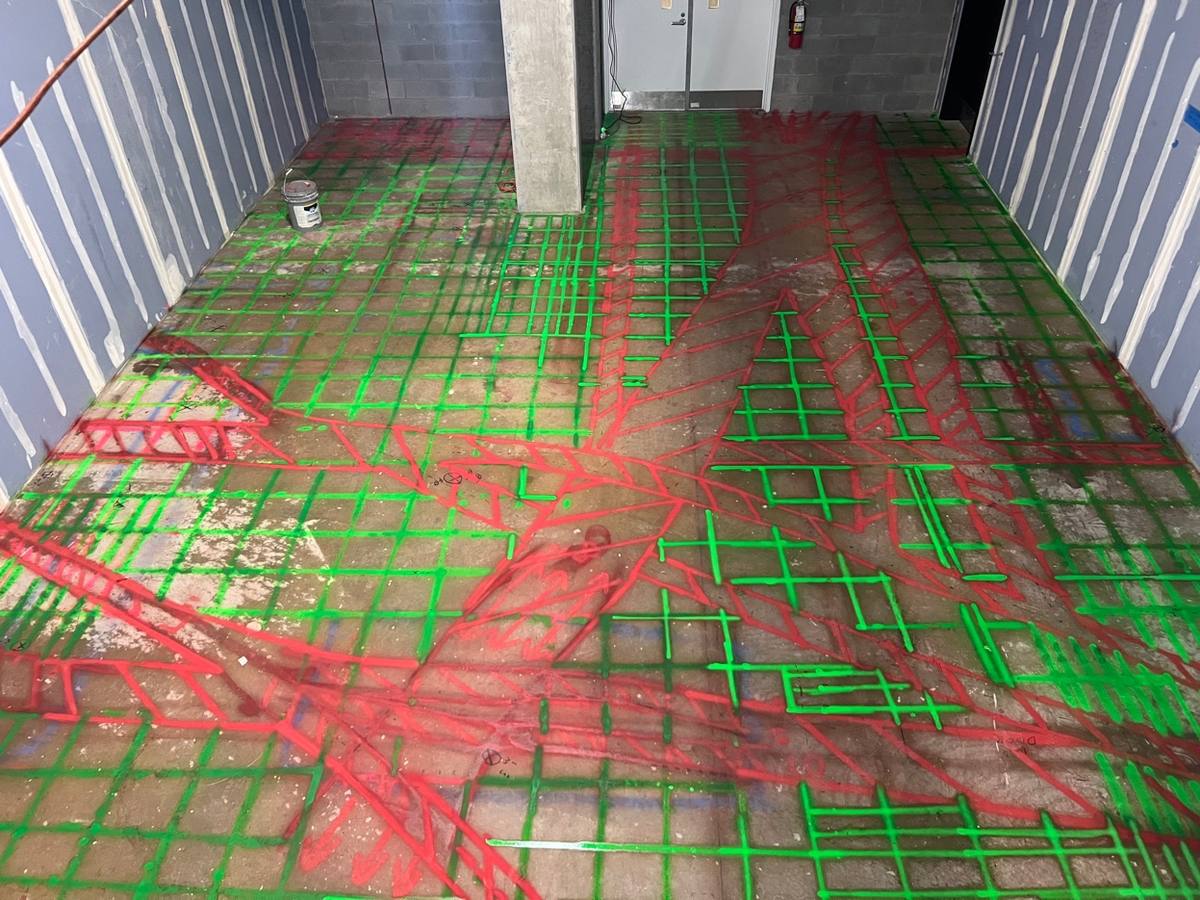
From the top they're all pretty much the same really. Gray, flat, nothing to see. Inside though it's a different story entirely.
| What's in the concrete | Where you'll find it | What happens if you hit it |
|---|---|---|
| Rebar | Pretty much every structural slab, wall, beam and column | Weakens the structure, and cutting main reinforcement may need an engineer to sign off |
| Post-tension tendons | Elevated decks, parking structures and a lot of slab-on-grade foundations | A cut tendon can let go suddenly, put your crew at risk and need a specialty repair |
| Electrical conduit | Slabs and walls in commercial and multifamily buildings | Shock and arc-flash risk, and the power goes out for whoever's in the building |
| Plumbing and radiant heat lines | Ground-floor slabs and heated floors | Water damage, shutdowns and an expensive floor repair |
| Voids | Under slabs and around old penetrations | Anchors that won't hold and holes that blow out |
Why the drawings aren't enough
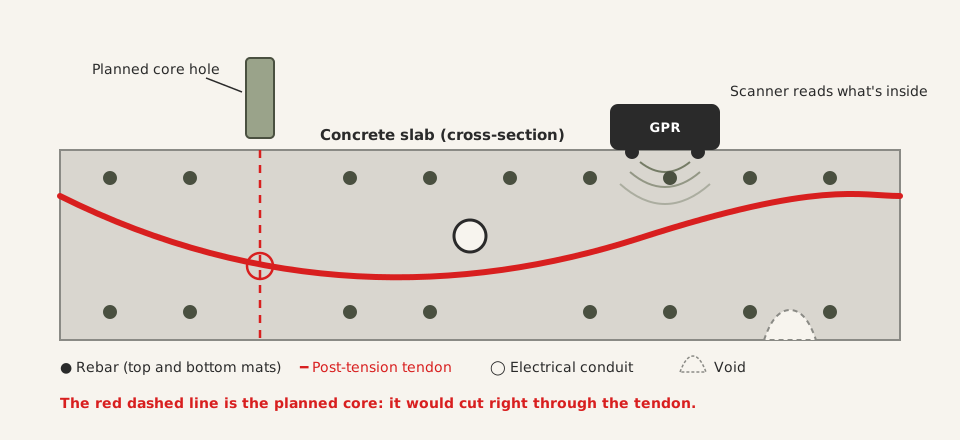
Drawings tell you what the engineer planned. They don't always tell you what got built. Conduit gets moved in the field to dodge something. Tendons get shifted. And plenty of older buildings don't have reliable drawings at all.
The scan shows what's in the concrete right now, at the exact spot you're about to cut. That's the only information that really matters when the bit hits the slab.
From the field: a 4-ton vat and a post-tension ceiling
Here's a good example. A GC was building out a restaurant in an apartment building in Salt Lake City's Granary District, and the kitchen needed a 4-ton vat hung from the ceiling. That ceiling was an elevated post-tension deck. On paper, the anchor spots looked fine.
I scanned the three anchor areas from underneath, and the slab was packed. Tendons ran both directions, with rebar in between. Several of the planned anchor holes were sitting right on top of a tendon.
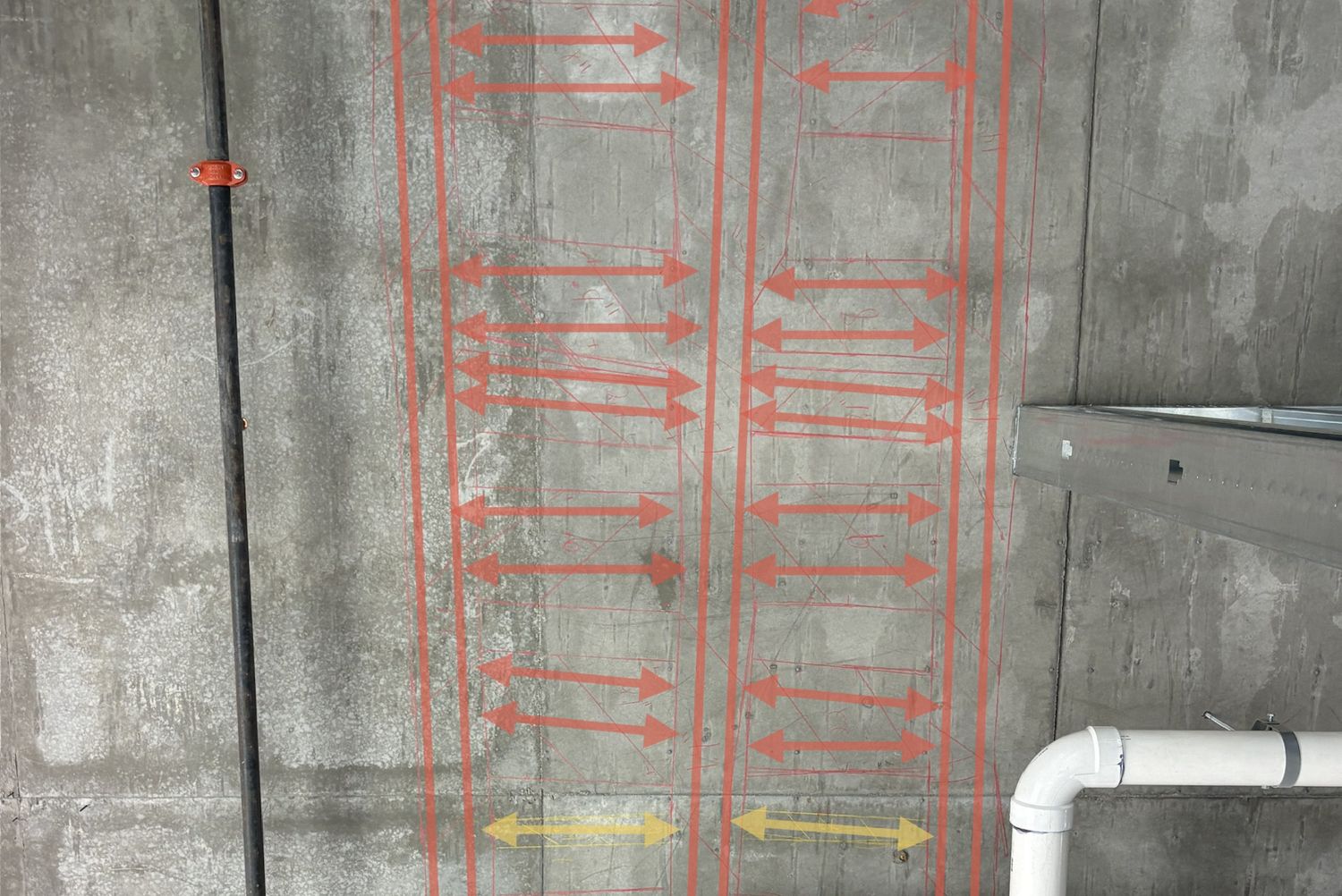
We marked everything on the ceiling, red for tendons and yellow for rebar, and the crew moved those anchors into clean concrete before anybody drilled. The report went out the next day. Read the full Granary District case study.
Jobs that need a scan first
Simple rule: if a blade or bit is going into concrete, get it scanned first. That covers:
- Core drilling for plumbing, electrical, fire sprinkler and HVAC penetrations
- Saw cutting for trenches, new openings, doorways and slab removal
- Anchoring heavy equipment, racking, handrails, bollards or EV chargers
- Trenching through a slab for underground plumbing on a tenant improvement
- Partial demo where part of the structure still has to stay in service
Digging outside the building too? Call 811 first, but keep in mind 811 only marks public utility lines. Water, sewer, power and gas lines that belong to the property owner don't get marked. That's where private utility locating comes in.
How a GPR scan works
GPR stands for ground-penetrating radar. The scanner sends radar pulses into the concrete and picks up what bounces back off steel, conduit and empty spaces. I roll it across the area, watch the screen as I go, and mark what's inside right on the surface.
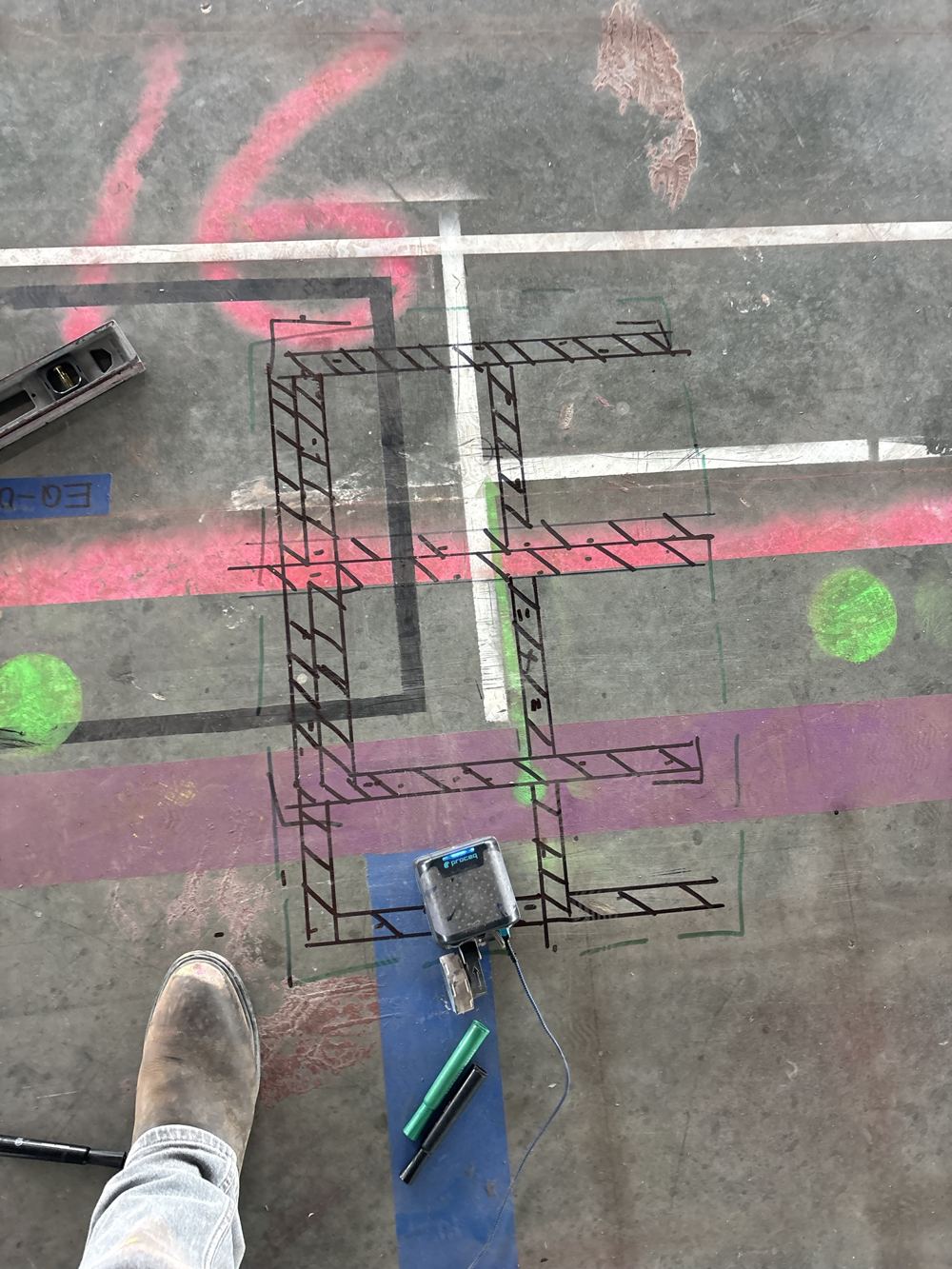
A typical job goes like this:
- You mark where you want to cut, core or anchor.
- We scan those spots and the area around them.
- Rebar, tendons, conduit and anything else we find gets marked on the concrete in different colors, with depth notes.
- Your crew cuts or drills in the clear zones, and any spot that lands on something gets moved.
- You get a written report within 24 hours for your records and the project file.
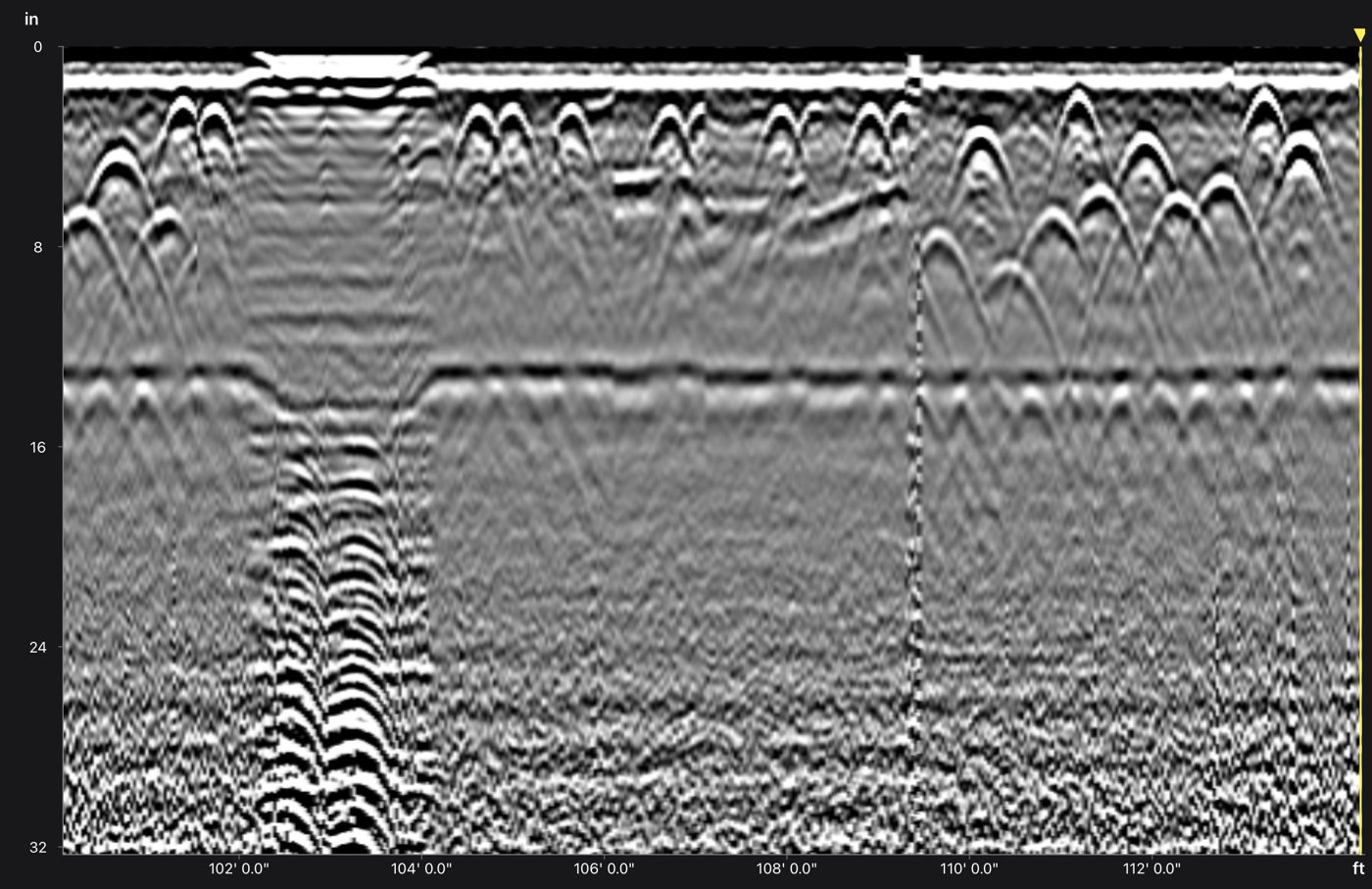
GPR vs. X-ray
X-ray has its place, but for most jobs GPR just makes more sense.
| GPR scanning | Concrete X-ray | |
|---|---|---|
| Access needed | One side of the slab or wall | Both sides |
| Radiation | None, so other trades can keep working | Yes, so the area has to be cleared during shots |
| Results | Real time, marked on the surface right away | Images processed after exposure |
| Best for | Most coring, cutting and anchoring on active job sites | Very congested or unusual elements that need a detailed image |
For most cutting and coring, GPR is quicker, nobody has to clear the floor, and the rest of the job keeps moving.
Scanning in Salt Lake City, Nashville and Phoenix
We work in three pretty different markets, and each one has its own headaches.
Salt Lake City and the Wasatch Front
Lots of elevated post-tension decks in newer apartment and mixed-use buildings, like the Granary District job above. We also see a lot of tenant improvements and retrofits in older buildings where the drawings are missing or out of date. Concrete scanning in Utah.
Nashville
Post-tension decks in high-rises and parking structures, plus dense rebar with live conduit running through it in commercial buildouts around downtown, Midtown and West End. The slab in the photo at the top of this post is a good example. Concrete scanning in Nashville.
Phoenix
The soil across the Valley expands and shrinks, so post-tensioned slab-on-grade is common in homes, warehouses and commercial buildings. Most of those slabs are designed to the Post-Tensioning Institute's slab-on-ground standard. That means even a ground-floor core for a plumbing remodel can hit a tendon. Engineers say the same thing: STRUCTURE magazine's article on existing post-tensioned foundations says to find the tendons before you drill. Concrete scanning in Phoenix.
What it costs, and what it saves
Scanning starts at $500, and most jobs land somewhere between $500 and $2,000, depending on how many areas we're scanning and how busy the slab is.
Fixing a cut tendon, conduit or major rebar? That commonly runs $10,000 to $80,000. And that's before you count the schedule delay, the engineer, and the risk to your crew.
Before you call: a quick checklist
Want the scan to go fast? Have these ready:
- Your cut, core or anchor locations marked, or the layout ready to go
- The slab type, if you know it (on grade, elevated, post-tensioned)
- A clear surface: no debris, standing water or stored material
- Any drawings you have, even old ones
- Whether both sides of the wall or deck are accessible
Common questions
Do I need concrete scanning before core drilling a single hole?
Yes, especially on an elevated or post-tensioned slab. It only takes one hole in the wrong spot to hit a tendon or a live conduit.
Does concrete scanning damage the slab?
Not at all. GPR is completely non-destructive. The scanner just rolls across the surface, and the only thing it leaves behind is the layout marking.
Can GPR tell post-tension cables apart from rebar?
An experienced tech can tell them apart by depth, spacing and pattern. If something can't be confirmed, it gets marked as a hazard and the cut or core moves to clear concrete.
How fast do I get results?
We mark everything on the concrete while we scan, so your crew can get to work the same day. The written report follows within 24 hours.